.avif)
The Controlling Test
The Convention Must Apply Between the Document’s Origin and Destination
Apostille or Legalization?
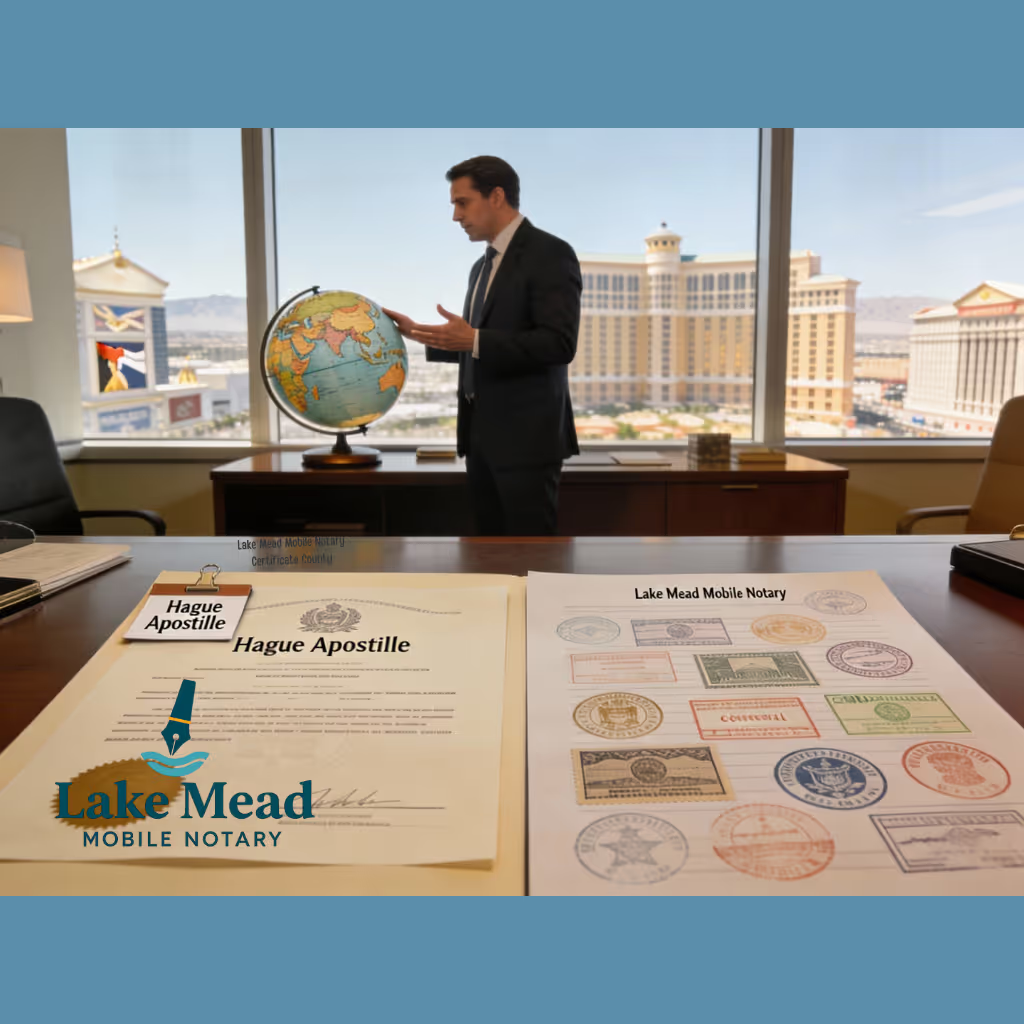
Use the Hague apostille route only when the Convention is in force between both countries and covers the public document.
When the Convention does not apply, the document may require an authentication certificate and a destination-country embassy or consular legalization stage. The exact chain depends on the document’s origin, the authority whose signature must be authenticated, and the receiving country’s current rules.
Calling a destination a “Hague country” is useful shorthand, but it is not a complete legal test. Entry dates, objections between countries, territorial extensions, and the document’s public-document status can change whether the Convention applies to a particular transaction.
Lake Mead Mobile Notary reviews the official country status and the receiving instructions before coordinating the Nevada stage. This prevents a Nevada document from entering the wrong state, federal, or consular route.
Confirm the Route Before We Process It
Let Lake Mead Mobile Notary review the document and destination
Send the document type, issuing state or authority, destination country or territory, receiving instructions, translation requirements, and deadline. Lake Mead Mobile Notary will identify the apparent Nevada, federal, apostille, or legalization route before confirming the service scope.
Hague Convention Route
What a Hague Apostille Replaces—and What It Does Not
For a covered public document moving between countries where the Convention applies, the apostille replaces the diplomatic or consular legalization formality addressed by the treaty.
-
Origin authentication
The apostille certifies the public signature, capacity, and seal or stamp
It confirms the origin of the public document. It does not certify that every statement in the document is true or that the recipient must accept the document for its intended purpose.
-
Public documents
The Convention covers defined categories of public documents
Court records, administrative records, notarial acts, and official certificates placed on private documents can fall within the Convention. The law of the document’s origin determines whether the document is public in nature.
-
Competent authority
The apostille comes from the authority connected to the document’s origin
Nevada state documents follow the Nevada authority, documents from another state follow that state, and qualifying federal documents follow the appropriate federal authority.
-
Recipient requirements
The apostille does not replace translation or substantive filing requirements
A court, consulate, registry, school, employer, bank, licensing body, or transaction party may still require a certified translation, current copy, supporting records, or a specific document format.
Non-Convention or Non-Covered Route
When Authentication and Embassy or Consular Legalization May Apply
“Embassy legalization” is common industry shorthand for a multi-authority process used when the Hague Apostille Convention does not govern the document’s use.
The destination is not covered by the Apostille Convention relationship
The document may require state or federal authentication followed by legalization through the destination country’s embassy or consulate, depending on the document and current receiving rules.
The country appears on the status table, but the Convention is not effective for the transaction
A new accession may not yet be in force, or an objection may prevent the Convention from operating between the document’s country of origin and the destination.
The destination is an overseas territory with separate Convention coverage
Treaty coverage may extend to some territories and not others. The specific territory named by the recipient must be reviewed rather than treated automatically as the sovereign country.
The document does not fall within the Convention route being assumed
Certain diplomatic, consular, commercial, or customs documents are outside the Convention’s ordinary public-document coverage, and the receiving authority may require a different certification path.
Current Country Review
What Must Be Confirmed Before Calling a Country “Hague” or “Non-Hague”
-
Both countries
The origin and destination must both be covered
The Convention applies to a public document executed in one covered country and presented in another. The destination’s participation alone is not enough.
-
Entry into force
The relevant treaty dates must have passed
A country may appear in the official status table before the Convention becomes effective for documents moving to or from that country.
-
Objections
The Convention must operate between the two countries
When a country joins by accession, another country may object within the treaty period. A timely objection can prevent the Convention from applying between that pair of countries.
-
Territories
The exact destination territory must be covered
A sovereign state’s Convention status does not automatically answer whether every overseas territory, dependency, or special jurisdiction is included.
-
Document scope
The paper must qualify as a covered public document
Document labels can be misleading. The relevant law, issuing authority, public signature, and any excluded category must be considered.
-
Receiving authority
The final recipient may require additional document preparation
Translation, certified-copy age, original-retention, witness, supporting-document, or filing rules can apply even when the authentication route is correct.
Competent Authority
Nevada, Other-State, Federal, and Foreign Documents Use Different Authorities
Nevada public signatures and Nevada notarial acts follow the Nevada state route
Eligible Nevada vital, court, academic, business, and notarized private documents are reviewed according to the Nevada public official or notarial signature involved.
A document issued or notarized in another state follows that state
A California public record, Texas court document, or Arizona notarization does not become a Nevada document because the holder is located in Las Vegas.
Federal public signatures use the appropriate federal authentication route
FBI records, federal court documents, consular records, and other federal documents do not share the Nevada state route used for Nevada public records.
A foreign-issued document follows the authority connected to its country of origin
Nevada cannot authenticate the foreign official’s original signature or seal. A later U.S. notarization or translation certification is a separate document and must be analyzed independently.
Avoidable Routing Problems
Mistakes That Can Send a Document Into the Wrong Authentication Chain
-
Static country list
Relying on an old list instead of current treaty status
Accession, entry-into-force dates, objections, withdrawals, and territorial extensions can change the correct route.
-
HCCH membership confusion
Assuming membership in the Hague Conference means the Apostille Convention applies
Membership in the organization and participation in the Apostille Convention are different legal questions.
-
Wrong authority
Sending a federal or out-of-state document through Nevada
The document’s origin and public signature control the competent authority, not the current location of the document holder.
-
Unready document
Processing an ordinary copy or incomplete notarization
The correct country route cannot cure a missing certified copy, defective certificate, unverifiable signature, or unsuitable document version.
-
Translation sequence
Translating before confirming whether the final certificate must be included
The recipient may require the apostille or legalization certificate to appear in the translated packet, making an early translation incomplete.
-
Acceptance assumption
Treating authentication as a guarantee of foreign acceptance
Apostille and legalization address document origin. They do not guarantee substantive sufficiency, filing approval, licensing, registration, visa approval, or transaction acceptance.
Coordinated International Authentication
How Lake Mead Mobile Notary Reviews the Apostille or Legalization Route
-
1
Inventory the documents and destinations
Provide each document type, issuing state or authority, destination country or territory, receiving organization, translation instructions, and deadline.
-
2
Identify the public signature and competent authority
Lake Mead Mobile Notary separates Nevada public officials and notaries from other-state, federal, and foreign authorities.
-
3
Verify the current Convention relationship
The origin, destination, entry date, objections, territorial coverage, and document scope are reviewed before the route is classified as apostille or legalization.
-
4
Make sure the Nevada document is ready before we process it
Certified-copy status, notarization, signature verification, destination information, translation sequence, and recipient instructions are reviewed for the confirmed Nevada stage.
-
5
Coordinate processing, status, and return logistics
Lake Mead Mobile Notary coordinates the confirmed service stages and communicates material issues without guaranteeing government, embassy, carrier, or recipient outcomes.
Common Questions
Hague Apostille and Embassy Legalization Questions
What is the main difference between an apostille and embassy legalization?
An apostille is the Convention certificate used for covered public documents moving between countries where the Hague Apostille Convention applies. When the Convention does not apply, a chain of authentication and embassy or consular legalization may be required.
How do I know whether the destination accepts apostilles?
The current official Convention relationship must be reviewed for both the document’s country of origin and destination, including entry-into-force dates, objections, territorial coverage, and the document’s public-document status. Lake Mead Mobile Notary performs this route review before confirming the service.
Does membership in the Hague Conference mean a country uses apostilles?
No. Membership in the Hague Conference on Private International Law is different from being a party to the Apostille Convention. The specific Convention status must be reviewed.
Can a Hague destination require embassy legalization after an apostille?
For a covered public document where the Convention applies between the origin and destination, the apostille replaces the diplomatic or consular legalization formality addressed by the Convention. The recipient may still require translation, supporting records, registration, or other substantive steps.
What happens when the destination is not covered by the Convention?
The document may require an authentication certificate and destination-country embassy or consular legalization. The exact route depends on the document origin, public signature, destination, and current receiving instructions.
Can Nevada process a federal or out-of-state document?
Nevada handles eligible Nevada public signatures and Nevada notarial acts. Documents from another state generally follow that state, while federal documents use the appropriate federal authority.
Does an apostille or embassy legalization prove that the document’s contents are true?
No. These processes authenticate the relevant public signature, capacity, and seal or stamp. They do not verify every statement in the document or guarantee acceptance for the intended foreign purpose.
What should I send Lake Mead Mobile Notary for route review?
Send the document type, issuing state or authority, a clear review copy when appropriate, destination country or territory, receiving instructions, translation requirements, and deadline. Do not send sensitive identification or payment information through an unsecured channel.
Start With the Document and Destination
Get the apostille or legalization route reviewed before processing
Provide the document type, issuing authority, destination country or territory, receiving instructions, translation requirements, and deadline. Lake Mead Mobile Notary will confirm the available Nevada service scope and coordinate the appropriate next stage.

.avif)


.avif)


