.png)
Notarizing School and Caregiver Forms in Nevada Guardianship and Minor Consent 2026
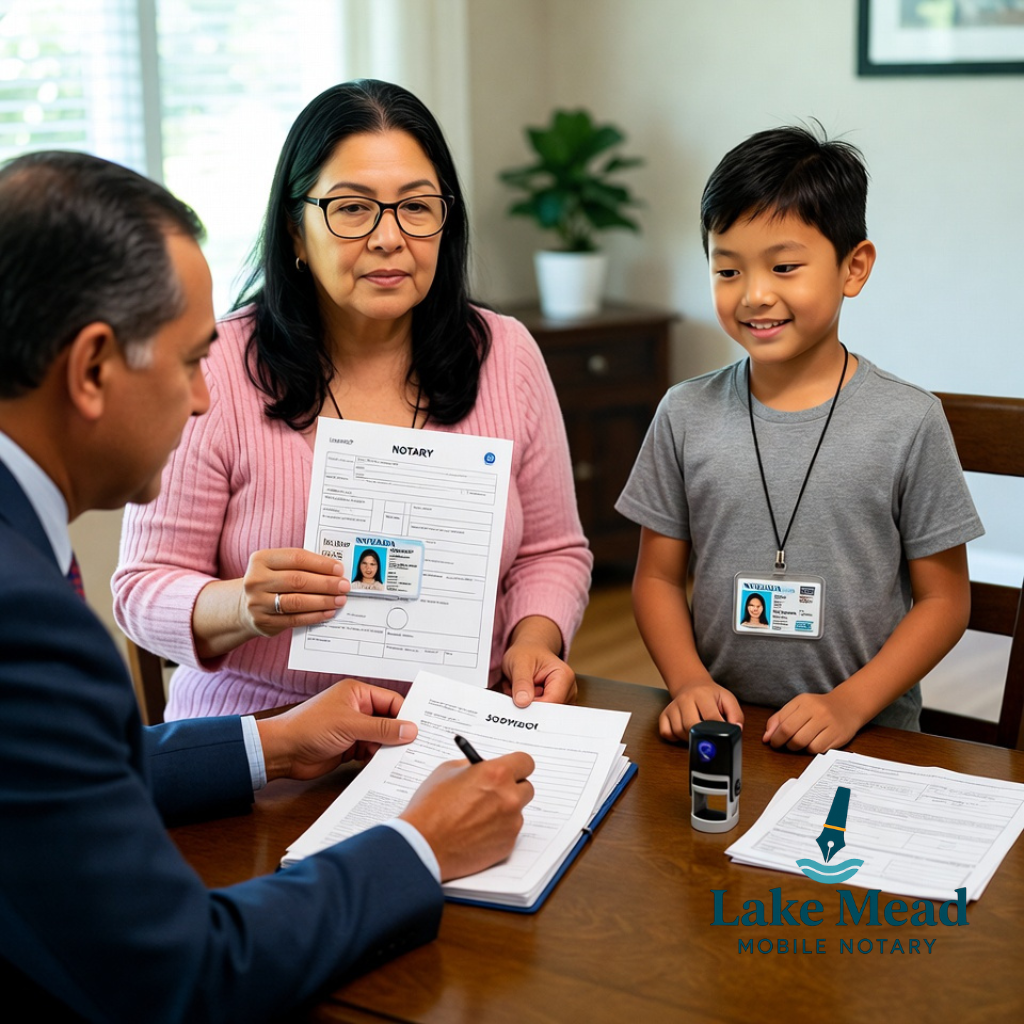
Nevada allows grandparents, relatives, and caregivers to temporarily care for children without court guardianship through informal temporary guardianship documents, but these forms must be properly notarized and comply with NRS 159.205 and school district requirements to be accepted by schools, hospitals, and medical providers. Lake Mead Mobile Notary helps Nevada families notarize temporary guardianship agreements, child medical consent forms, school guardian affidavits, and residential affidavits at homes, senior communities, and family locations across Las Vegas and Henderson. When caregivers need to enroll a child in school, authorize medical treatment, arrange travel, or handle emergency decisions without going to court, properly notarized forms provide clear legal authority that schools, doctors, and hospitals will recognize. Many grandparents raising grandchildren, aunts and uncles caring for nieces and nephews, and family friends serving as temporary guardians face confusion about which forms need notarization and exactly how to execute them under Nevada law. This guide explains temporary guardianship requirements under Nevada law, shows which school and medical forms require notarization, and demonstrates how mobile notarization makes the process faster and less stressful for families in caregiving situations.
Nevada allows grandparents, relatives, and caregivers to temporarily care for children without court guardianship through informal temporary guardianship documents, but these forms must be properly notarized and comply with Nevada law (NRS 159A.205) to be accepted by schools, hospitals, and medical providers.
When grandparents are raising grandchildren, aunts and uncles are caring for nieces and nephews, or family friends are serving as temporary guardians, properly notarized guardianship and consent forms provide clear legal authority that schools, doctors, and hospitals will immediately recognize without court involvement. Lake Mead Mobile Notary helps Nevada families notarize temporary guardianship agreements, child medical consent forms, school guardian affidavits, and residential affidavits at homes, senior communities, and family locations across Las Vegas and Henderson.
This guide explains temporary guardianship requirements under Nevada law, shows which school and medical forms require notarization, and demonstrates how mobile notarization makes the process faster and less stressful for families in caregiving situations.
Nevada law allows a parent with legal custody to appoint a temporary guardian for an unmarried minor child without court approval through a simple written agreement. This is the fastest, most informal way for grandparents, relatives, or family friends to gain authority to make daily care decisions for a child.
The form becomes effective immediately upon execution and notarization. It does not require filing with the court or any government agency. Schools, hospitals, and medical providers will accept the notarized form as proof of authority to make daily care and medical decisions.
A temporary guardianship under NRS 159A.205 is informal and limited. It allows day-to-day care decisions but does not give the guardian authority to sell property, make permanent medical decisions (like surgery without parental consent), or permanently change the child's residence without parental approval. For more extensive authority, families may need a court-appointed guardianship under NRS 159A.052 or 159A.053, which requires a petition and court order.
Hospitals, clinics, and medical providers require notarized medical consent forms to authorize guardians to make treatment decisions for children. Without proper notarization, providers may delay or refuse care.
When guardians travel with children, schools and travel companies may require notarized forms confirming custody and authorization for travel.
Notarizing guardianship and consent forms is straightforward when you follow these steps:
| Step | What To Do | Important Notes |
|---|---|---|
| 1. Prepare Form | Complete the guardianship or consent form in full, but LEAVE SIGNATURES BLANK. Have all required information filled in (names, dates, term of guardianship). | Do not sign before the notary. Forms with pre-existing signatures may be rejected by notaries or institutions. |
| 2. Gather IDs | Collect valid government-issued photo IDs for all signers (parent, guardian, child if 14+). Driver's license, passport, or state ID card acceptable. | Notary will verify identity using ID. Expired but recognizable IDs usually accepted; current ID preferred. |
| 3. Schedule Notary | Book mobile notary through Lake Mead Mobile Notary. You can schedule at home, school, hospital, or any convenient location. Same-day service available. | Mobile notary eliminates travel time and works with caregiver schedules (evenings, weekends available). |
| 4. Bring Documents | Bring the unsigned form, all IDs, and any supporting documents (temporary guardianship order if from court, proof of custody if needed). | Notary may ask to review form to confirm type of notarization needed (acknowledgment vs. jurat). |
| 5. Sign Before Notary | All signers must sign the document IN FRONT OF the notary. Parent and guardian can sign separately; child (14+) signs separately if required. | This is essential. Notary will not notarize pre-signed documents or allow signatures outside the notary's presence. |
| 6. Notary Verification | Notary verifies identity of all signers, asks if they signed willingly, and confirms understanding of the document. | Notary may ask questions like, "Do you understand what you're signing?" This is standard and required by Nevada law. |
| 7. Certificate Applied | Notary applies the appropriate certificate (acknowledgment or jurat) based on document type and recipient requirements. Notarial seal and signature added. | If unsure which certificate is needed, notary can contact school/hospital to confirm before applying certificate. |
| 8. Receive Originals | You receive the original notarized documents. Keep in safe place. Make copies for school, hospital, doctor office records as needed. | Original notarized form has legal weight. Photocopies are acceptable for most institutions (verify with each). |
Schools, hospitals, and courts will reject documents that are pre-signed. Notary must witness the signature. Solution: Sign the form only in front of the notary, never before.
Medical providers and courts often need a jurat (sworn statement), not an acknowledgment. If you use the wrong certificate, the document will be rejected. Solution: Ask your school or hospital which certificate they require before the notary appointment, or let your mobile notary contact them to confirm.
A temporary guardianship must be signed by BOTH the parent with custody AND the designated guardian (separately is OK). If only one signs, it's invalid. Solution: Ensure both parent and guardian are present or arrange separate notarization times with both.
Notary must verify signer identity. Expired driver's licenses may be accepted if still recognizable, but some lenders and agencies require current ID. Solution: Bring the most recent valid government-issued photo ID you have (passport, current driver's license, or state ID card).
For minors 14 and older, Nevada law requires the child's written consent for temporary guardianship under NRS 159A.205. Without this, the document is invalid. Solution: Have the minor sign a consent form (notarized) at the same appointment or before.
No. Under Nevada law, signers can sign separately, and the notary can notarize each signature individually. This is especially helpful for grandparents who may not be able to meet with parents at the same time. Mobile notaries can visit different family members on the same day or coordinate separate appointments.
Not ideally. The notary cannot notarize a signature that was not made in the notary's presence. If the parent has already signed, the notary can acknowledge the existing signature (verify the parent signed willingly), but some institutions may reject this. Best practice: Have all signers sign in front of the notary or arrange fresh signatures.
Most schools and hospitals will accept it IF properly notarized. However, some may require a court-appointed guardianship for certain decisions (like surgery). If the informal temporary guardianship is rejected, families may need to pursue court guardianship under NRS 159A.052 or 159A.053, which requires a petition and judge's order.
Under NRS 159A.205, a temporary guardianship lasts up to 6 months (or shorter term if specified in the document). After that, a parent can renew it by executing a new notarized form. There is no formal filing, so schools and hospitals keep copies on file. Always provide updated originals if the guardianship is renewed.
It depends on the receiving state. Nevada temporary guardianship is recognized in Nevada but may not be fully recognized in other states. For travel outside Nevada, families should contact the destination state or consult an attorney about whether additional documentation (like an apostille) is needed. International travel may require additional forms or documents beyond notarization.
Under NRS 159A.205, a parent can terminate a temporary guardianship by executing a new written instrument signed by the parent with legal custody. The termination should also be notarized to create a clear record. Schools and hospitals should receive notice of the termination. This is why mobile notaries help families document all guardianship changes clearly.
Grandparents, relatives, and caregivers in Nevada deserve fast, professional notarization services that don't require court involvement or unnecessary delays. Lake Mead Mobile Notary specializes in notarizing guardianship agreements, child medical consent forms, school affidavits, and travel authorizations at homes, senior communities, and family locations across Las Vegas and Henderson.
We understand the urgency when children need school enrollment or medical care, and we're available seven days a week with same-day service for families facing time-sensitive situations.
Professional notarization for temporary guardianship agreements, child medical consent, school affidavits, and travel authorization forms. Mobile service to your home, office, or family location.
.png)





.png)